The Fifteen-Second Test That Predicts More Than Your Cholesterol Panel
A hand dynamometer costs about as much as a decent pair of running shoes, takes fifteen seconds to use, and — according to a growing pile of longevity research — can say more about your next two decades of health than most items on a standard blood panel. Squeeze the handle as hard as you can, three times per hand, and a number pops up in kilograms. That number is grip strength, and over the past two years it has quietly moved from a niche geriatric-medicine metric to something women in their thirties and forties are tracking on purpose, right alongside resting heart rate and sleep score.
It sounds like an odd thing to obsess over. Nobody's career depends on how hard they can crush a hand grip. But grip strength turns out to be one of the more honest proxies researchers have found for overall muscular and skeletal health, and unlike a lot of wellness-trend numbers, this one has real clinical weight behind it — geriatricians have used handgrip dynamometry for years to flag frailty risk in older patients, and the same test is now migrating into general checkups and DIY fitness tracking well before frailty is anywhere on the horizon.
What Grip Strength Actually Predicts
It's not really about your hands.
Grip strength correlates strongly with total-body muscle mass, because the forearm muscles that do the squeezing are wired into the same neuromuscular system that keeps your back, hips, and core functional. A large UK Biobank analysis tracking roughly half a million adults over several years found that low grip strength was associated with higher rates of cardiovascular disease, poorer cognitive performance, and increased all-cause mortality — independent of age, smoking status, and general activity level. Nobody is claiming a weak grip causes a heart attack. The mechanism runs the other way: grip strength is a fast, cheap stand-in for how much lean muscle tissue you're carrying and how well your nervous system can recruit it, and both of those things independently predict how well a body ages.
The bone connection is just as direct. Muscle and bone respond to the same mechanical loading signals, so a stronger grip — built through carrying, hanging, and pulling — tends to travel with higher bone mineral density in the wrist, hip, and spine. That matters enormously for women specifically, since bone density starts declining faster than men's in the decade around menopause, and wrist and hip fractures are two of the most common injury categories once that decline sets in. Grip strength won't stop the drop in estrogen that drives it. It can measurably slow how much bone you lose along the way, which is a different and more useful claim than most supplement ads make about the same problem.
What "Good" Looks Like by Age
Clinical sarcopenia guidelines from the European Working Group on Sarcopenia in Older People set the low-strength cutoff for women at 16 kilograms on a Jamar-style dynamometer — below that, a clinician starts screening for muscle loss regardless of how old the patient is. That's the floor, not a target. In practice, healthy women in their twenties and thirties typically test somewhere between 25 and 32 kilograms per hand, women in their forties and fifties more commonly land in the low-to-mid twenties, and the number keeps sliding after sixty unless someone actively trains against it.
You don't need a clinical dynamometer to get a useful read. A simple dead hang from a pull-up bar works as a rough field test: hang with straight arms, feet off the floor, and time how long you can hold on before your grip gives out.
- Under 10 seconds suggests grip strength is genuinely limiting, worth addressing on its own before anything else
- 20–40 seconds is a reasonable baseline for an untrained but otherwise active woman
- Past 60 seconds usually means someone already does regular hanging, climbing, or heavy carrying work, whether or not they'd call it "grip training"
These field numbers are rougher than a lab dynamometer reading and shift with body weight, wingspan, and how recently you've trained — treat the ranges as a compass, not a diagnosis.
Building It: The Training That Actually Moves the Number
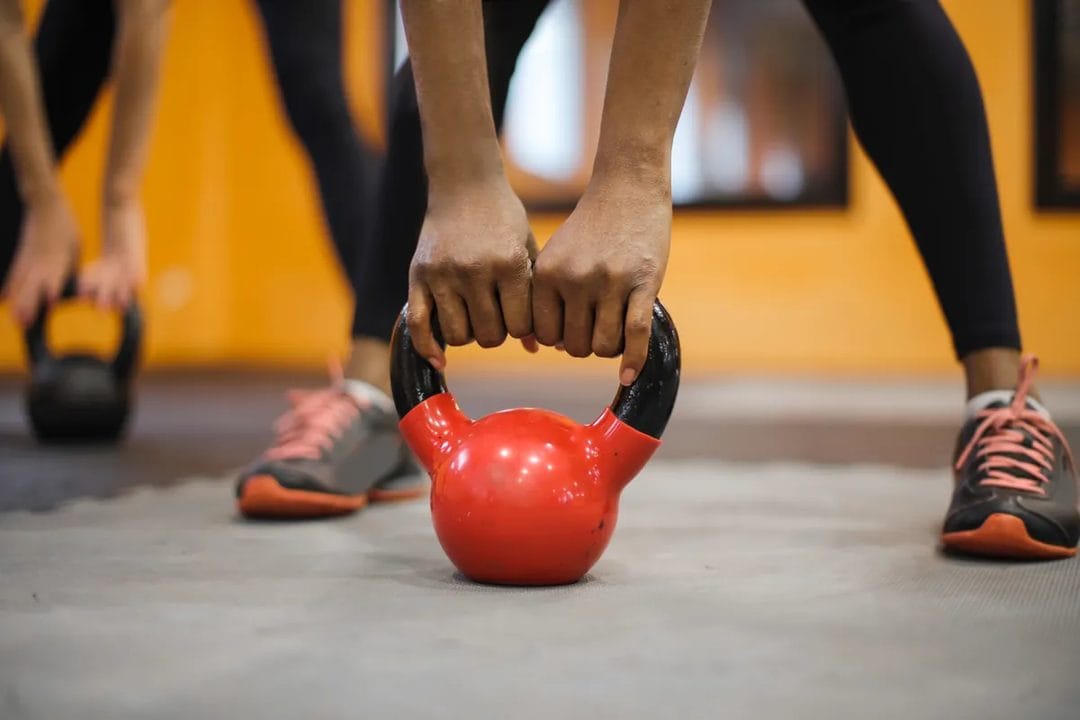
Farmer's carries are the single best exercise for building real-world grip strength — better than wrist curls, better than isolated grippers used alone. Pick up a pair of heavy dumbbells or kettlebells, roughly 50–70% of your bodyweight combined, and walk for 30–40 meters. The load forces your hand to maintain a crush grip under fatigue for the entire distance, which is a much closer match to how you actually use grip strength in daily life — hauling grocery bags, carrying a toddler on one hip while dragging a suitcase with the other hand, holding a stair rail with a full arm's worth of shopping.
Dead hangs make for a satisfying gym-selfie moment, and they're genuinely useful for shoulder health, but the catch is that they mostly train crush and support grip and do little for the pinch grip you use opening a jar lid or carrying a laptop bag by its thin strap. A complete routine needs at least one exercise from each category: crush (grippers, farmer's carries), support (dead hangs, towel pull-ups), and pinch (plate pinches, holding two weight plates smooth-side-out between thumb and fingers).
- Farmer's carries — two sets of 30–40 meters, twice a week, as heavy as you can manage while keeping shoulders packed down
- Dead hangs — build toward three sets of 30–45 seconds; a resistance band under the feet takes weight off if a full bodyweight hang isn't there yet
- Kettlebell swings — the ballistic grip demand at the top of each rep trains crush strength under speed, not just under a static load
- Rock climbing or bouldering, once a week if a gym is nearby — nothing else trains crimp and pinch grip as directly, and it doesn't feel like training at all
Two sessions a week, sustained for eight to twelve weeks, is enough to move most women's numbers meaningfully. Skip the cheap spring-loaded grippers sold at drugstore checkout counters; a set of adjustable grippers from a brand like Captains of Crush costs more but actually allows progressive overload, which is the entire point of tracking a number in the first place.
Where This Fits in the Bigger Strength Story
Grip strength didn't appear out of nowhere as a trend. It's the latest, most measurable expression of a shift that's been building for a few years: women moving away from cardio-only routines and toward resistance training as the priority, driven partly by longevity research and partly by a simple cultural permission shift away from the old fear of "getting bulky." Kettlebells, barbells, and weight rooms that used to skew heavily male now fill up with women in their thirties, forties, and fifties who read the same bone-density and muscle-mass research and decided the treadmill wasn't going to cut it alone.
What makes grip strength different from, say, tracking your squat max is accessibility. Not everyone has a barbell or a coach. Almost everyone can find a pull-up bar, a couple of heavy bags, or a $30 hand dynamometer, and get a number that means something clinically validated rather than just personally satisfying. Test it now, write the number down, and test again in three months — that's a longevity metric you can actually see move.