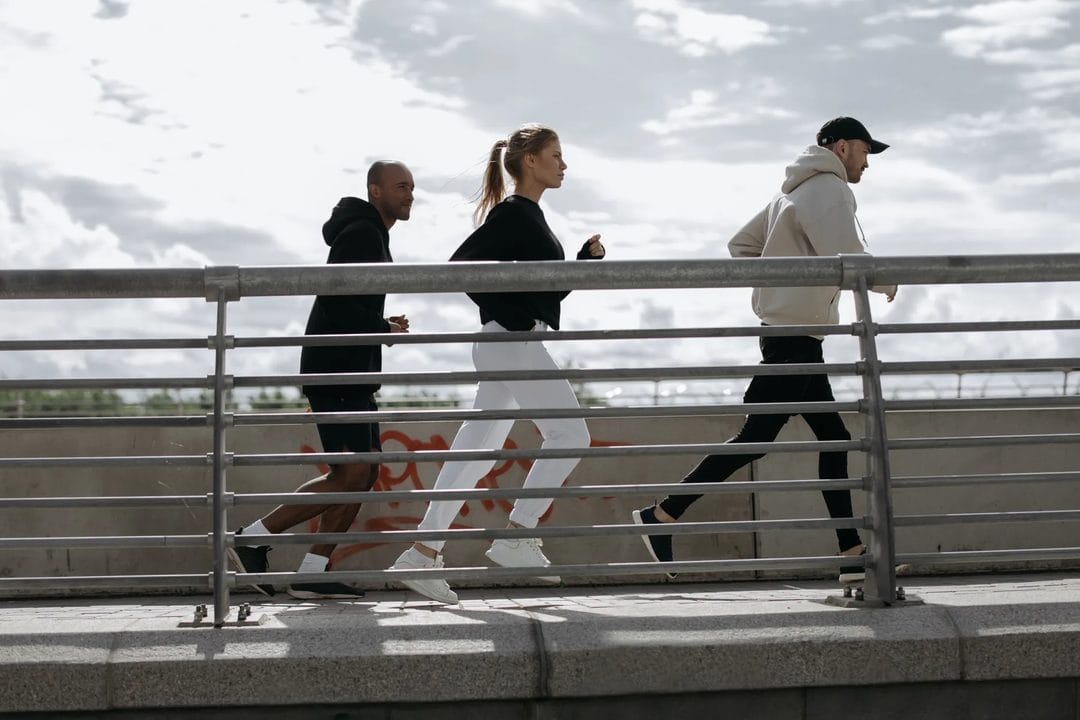
Sociologist Ray Oldenburg coined the term "third place" back in 1989 to describe the informal public spaces — cafes, bars, barbershops — that sit outside home (the first place) and work (the second), and for decades the dating world quietly ignored the concept entirely. A first date meant a bar. Dim lighting, a drink you ordered mostly to have something to do with your hands, and a conversation with the specific pressure of two strangers evaluating each other across a small table with nothing else going on. That default is fading fast, and what's replacing it — run clubs, climbing gyms, pottery studios, farmers markets — is less a trend than a correction to something that never made much sense in the first place.
The run club takeover is not subtle
Run clubs built around dating and mingling — not competitive racing, just a shared 5K and a coffee afterward — have gone from a niche Brooklyn thing to a fixture in most mid-size cities over the past two years. November Project, once a scrappy volunteer-run fitness community, now has chapters in dozens of cities, and newer, explicitly social-first groups have followed the same template: show up, run three to five miles at a conversational pace, stick around for coffee where the actual talking happens. Strava's own user data has shown a steady rise in group-run activity logged on Saturday and Sunday mornings, and dating apps have taken notice — Bumble added run-club-specific event listings inside its app in several major markets, treating them as a legitimate first-date category rather than a fitness afterthought.
The appeal isn't really about fitness, even though that's the surface pitch. It's about the fact that a run gives two people something to do besides stare at each other and perform interestingness on command. You're moving, breathing hard, occasionally silent for thirty seconds without it being awkward — which is a genuinely rare thing on a first date. Compare that to a bar, where silence at minute four reads as a red flag instead of just a normal gap in a conversation between two people who met an hour ago.
What changed isn't the venue — it's the pressure
A drink-based first date puts the entire evening's success or failure on conversation alone, for ninety uninterrupted minutes, with nowhere to look except each other's face. That's an enormous amount of social pressure to put on two people who, statistically, have exchanged maybe forty messages on an app before meeting in person. A shared activity — climbing, a pottery class, a farmers market walk — distributes that pressure across something else happening in the room. You're not carrying the entire date on witty banter; you're also climbing a wall, or shaping clay badly, or comparing tomato varieties at a stall, and the conversation happens in the gaps rather than being the whole event.
This matters more for women specifically, and it's worth saying directly rather than hedging around it: a daytime activity date in a public space with other people around solves a real safety calculus that a dim bar with a stranger doesn't. Meeting at 7 AM for a run club with fifteen other regulars present, in daylight, with an established route and a coffee shop as the known endpoint, removes a whole category of first-date anxiety that no amount of "trust your gut" advice actually addresses. It's not that bars are inherently unsafe. It's that a run club with a dozen witnesses and a fixed schedule requires zero vigilance compared to a one-on-one meetup somewhere you're evaluating an exit strategy the whole time.
There's a real financial angle too, and it's not a small one at current bar prices. A round of two cocktails in most major U.S. cities now runs $28 to $40 before tip, and that's before a second round that either person feels obligated to offer. A run club is free. A drop-in pottery class runs $35–$55 for a two-hour session that includes the activity and the conversation, and a farmers market costs whatever produce you actually buy. For a generation of daters who are, by most cost-of-living measures, more financially cautious than the cohorts before them, "free or under $40 and I get a workout or a bowl out of it either way" is a meaningfully different proposition than $70 on drinks with someone you might never see again.
The apps are already redesigning around it
Dating apps have noticed the shift and are building product around it rather than just watching from the sidelines. Hinge's in-app prompts have leaned harder into activity-based icebreakers over the past couple of product cycles — "the way to win me over is [blank]" answers skew heavily toward specific activities rather than restaurants now, according to patterns the company itself has highlighted in its own trend reporting. Bumble's event-listing feature, which surfaces local run clubs, art classes, and volunteer meetups as first-date-adjacent options, treats the activity itself as the match rather than a backdrop to a conversation between two people who swiped right on each other's photos. That's a meaningful product shift: it's no longer just "here's a person, go figure out what to do," it's "here's a thing happening Saturday, and here are people also going."
Introverts and extroverts experience this shift differently, and it's worth being honest that it isn't a universal upgrade. Someone who finds one-on-one conversation easier than group settings might genuinely prefer the concentrated, no-distractions format of a quiet dinner date over a run club with fifteen other regulars milling around — the group setting that removes pressure for one person can add a different kind of pressure for another, the low hum of performing normally in front of strangers rather than just one stranger. There's no single format that works for everyone, which is probably the actual lesson here rather than "run clubs beat bars."
Where it doesn't work as well
The honest caveat here is that activity dates make it genuinely harder to read romantic chemistry in the moment, and that's a real trade-off, not a minor one. You can have a great two hours at a climbing gym with someone and walk away without knowing whether there was actual romantic interest or just a fun shared activity with a friendly stranger — the ambiguity that a bar date, for all its flaws, tends to resolve faster. Several people I've talked to about this describe needing a second, quieter date specifically to figure out what the first one didn't tell them, which adds a step that a traditional dinner-and-drinks date sometimes skips.
It also doesn't fully replace the late-evening date — nobody's meeting for a run club at 9 PM, and there's still a place in dating for an evening that isn't scheduled around daylight and a sweat towel. What's actually happening is less a total replacement than a shift in what the *first* date looks like specifically, with the traditional dinner-and-drinks format moving to date two or three, once there's enough established interest to justify the higher-pressure, higher-cost format.
The bar isn't dead as a dating venue. It's just no longer the default opening move — and for a generation that grew up watching dating shows stage every first meeting in a bar or restaurant, quietly opting for a 6:30 AM group run instead is its own small rebellion.