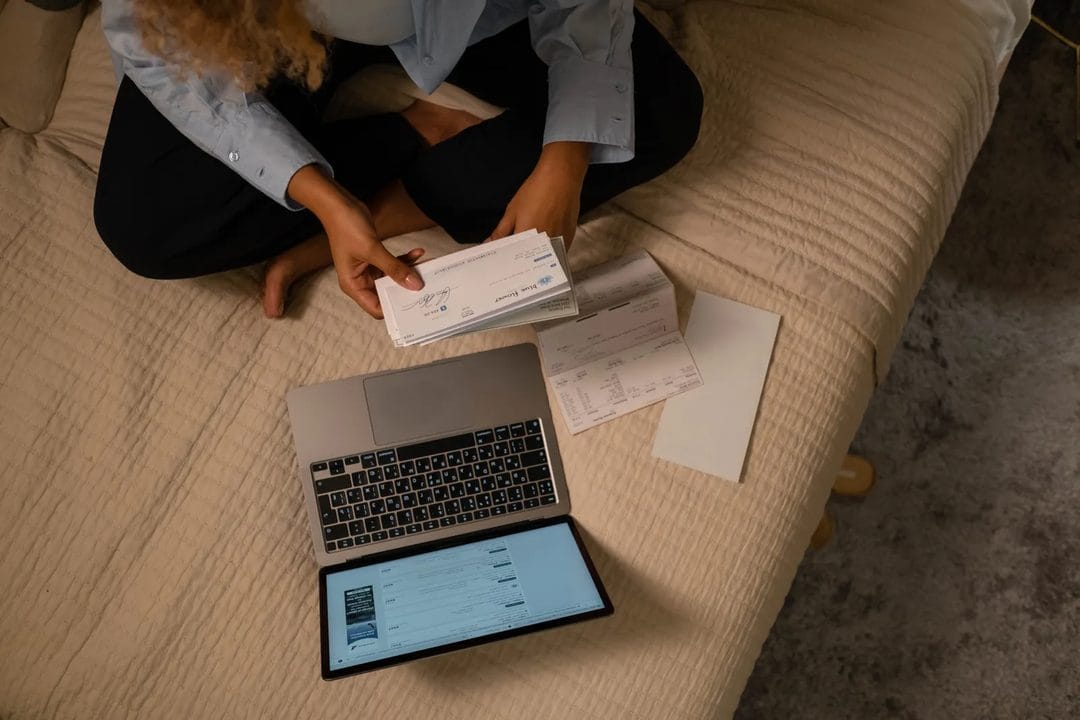
A woman I know — thirty-four, a stable salary, six months of expenses sitting in a savings account, no debt beyond a mortgage she can comfortably afford — described her relationship with money to me last month as “constant low-grade panic.” She checks her banking app most days, sometimes several times, not because anything is wrong but because she doesn't fully believe the number on the screen is real. By every conventional measure she's financially secure. She doesn't feel it, and she's not alone in that gap — therapists and financial planners have started using a specific term for it this year: money dysmorphia, the persistent, often irrational sense that your financial situation is worse than the numbers actually show.
The term borrows its structure deliberately from body dysmorphia, and the comparison holds up better than most borrowed psychology terms do. In both cases, the gap isn't between reality and a lie — it's between reality and a distorted internal read of that reality, one that doesn't correct itself just because someone shows you the accurate version. You can hand a woman with money dysmorphia her own bank statement, walk her through the maths, and watch the anxiety barely move, because the feeling was never actually generated by the numbers in the first place.
Where the feeling actually comes from
Part of it is generational timing. Women now in their late twenties through forties came of age watching the 2008 financial crisis as teenagers or young adults, graduated into a job market reshaped by 2020, and have spent the years since watching housing costs and grocery bills climb faster than most paychecks did. A 2023 Bank of America survey found that 53% of Gen Z respondents and 42% of millennials reported feeling behind financially regardless of their actual account balances — a gap between lived experience and lived numbers that doesn't close just because someone's individual situation happens to be fine.
Social media does a specific kind of damage here that older generations didn't have to contend with in quite the same way. It's not simply that Instagram shows curated wealth — that criticism is old news by now — it's that finance content specifically has become a genre of its own, full of 24-year-olds narrating six-figure net worths, side hustles that supposedly replaced a salary in eighteen months, and a tone that implies anyone not doing the same is falling behind on a race nobody agreed to enter. Scroll that content for twenty minutes and a genuinely comfortable financial position can start to feel inadequate purely by comparison, which is precisely the mechanism that makes money dysmorphia so resistant to being talked out of with facts.
The two faces of the same distortion
Money dysmorphia doesn't show up as one single behaviour, and that's part of why it goes unnamed for so long — it looks like two opposite things depending on the woman.
- The scarcity version: checking the banking app compulsively, refusing to spend on things that are genuinely affordable, feeling guilt over a coffee purchase while a healthy emergency fund sits untouched.
- The avoidance version: refusing to look at statements at all, avoiding retirement account balances, spending in a way that would be reckless for someone actually struggling — because looking directly at the number feels worse than not knowing it.
- Some women cycle between both within the same month, tight and restrictive after payday, avoidant and spend-heavy three weeks later, which looks like inconsistency but is really the same anxiety wearing two different outfits.
What both versions share is a refusal to let the actual data update the feeling. A woman in the scarcity camp can recite her own savings rate accurately and still feel poor saying it out loud. A woman in the avoidance camp often has a rough sense her situation is fine and avoids confirming it anyway, because confirmation would remove the vague anxiety that's become oddly familiar.
Why this shows up harder for women specifically
The gender gap in this particular anxiety isn't incidental. Women still retire, on average, with meaningfully less saved than men in comparable roles — a persistent effect of the gender pay gap compounding over a working lifetime, plus the career interruptions that disproportionately fall on women for childcare and eldercare. That's a real, structural reason for financial caution to run higher among women as a group. But money dysmorphia isn't proportional caution — it's caution that's detached from an individual woman's actual numbers, and the structural reality of the gap can end up amplifying an anxiety that, for any one specific woman, isn't actually matched by her own financial position. Knowing the statistic is real doesn't mean every individual woman reading it is personally behind, and that distinction gets lost easily.
There's also a longer cultural thread here worth naming directly: many women were raised in households where money was either never discussed openly or discussed only as a source of tension, which leaves adulthood with no calibrated internal sense of what "enough" actually feels like. Without that calibration, the nervous system defaults to threat — better to feel poor and be wrong than to feel secure and be caught off guard. It's a defensible survival instinct in the wrong context, applied to a spreadsheet instead of the situation it evolved for.
What actually helps, and what doesn't
More budgeting apps rarely fix this, and that's worth saying plainly, because the instinct when money anxiety flares is almost always to download another tracker. Tracking spending more granularly helps with actual overspending. It does very little for a distortion that isn't rooted in the numbers to begin with. What financial therapists — a small but growing specialty that blends certified financial planning with clinical training — report working better is naming the pattern out loud to someone else, specifically, rather than running the numbers again in private for the fortieth time.
A concrete exercise several financial therapists recommend: write down your actual net worth or savings figure on paper, then separately write down the number you feel like you have, without checking anything. The gap between those two numbers, made visible instead of vague, is often the first moment a woman realises the anxiety was never really about the account balance at all — it was about something closer to safety, or worth, or control, wearing a financial costume. That reframe doesn't dissolve the feeling overnight. It does usually stop the compulsive checking, because checking stops promising an answer it was never going to give.
Muting specific finance influencers, not finance content generally, tends to help more than people expect — the goal isn't avoiding all financial information, which just trades one kind of avoidance for another. It's cutting the specific accounts that reliably trigger the comparison spiral, the ones narrating net worths in a tone built for engagement rather than honesty. And for the genuinely severe cases — daily panic, physical symptoms, spending or saving behaviour that's actively damaging a stable financial position — a financial therapist or a regular therapist with financial-anxiety experience is a real referral, not an overreaction. This isn't a character flaw that discipline fixes. It's a distortion, and distortions respond to a different kind of correction than a better spreadsheet.